Exhibition
Landscape has come to signify far more than a depiction of nature. It is increasingly borrowed to describe political conditions, social transformations, and the terrain of mass media. The proliferation of this term across various disciplines has managed to break the association I once had in my mind: green fields, blue skies, wide horizons…a contemplative mental image offering a fleeting glimpse into something one could get lost in. These serene scenes, though never permanent, seem to have drifted far away from our own reality.
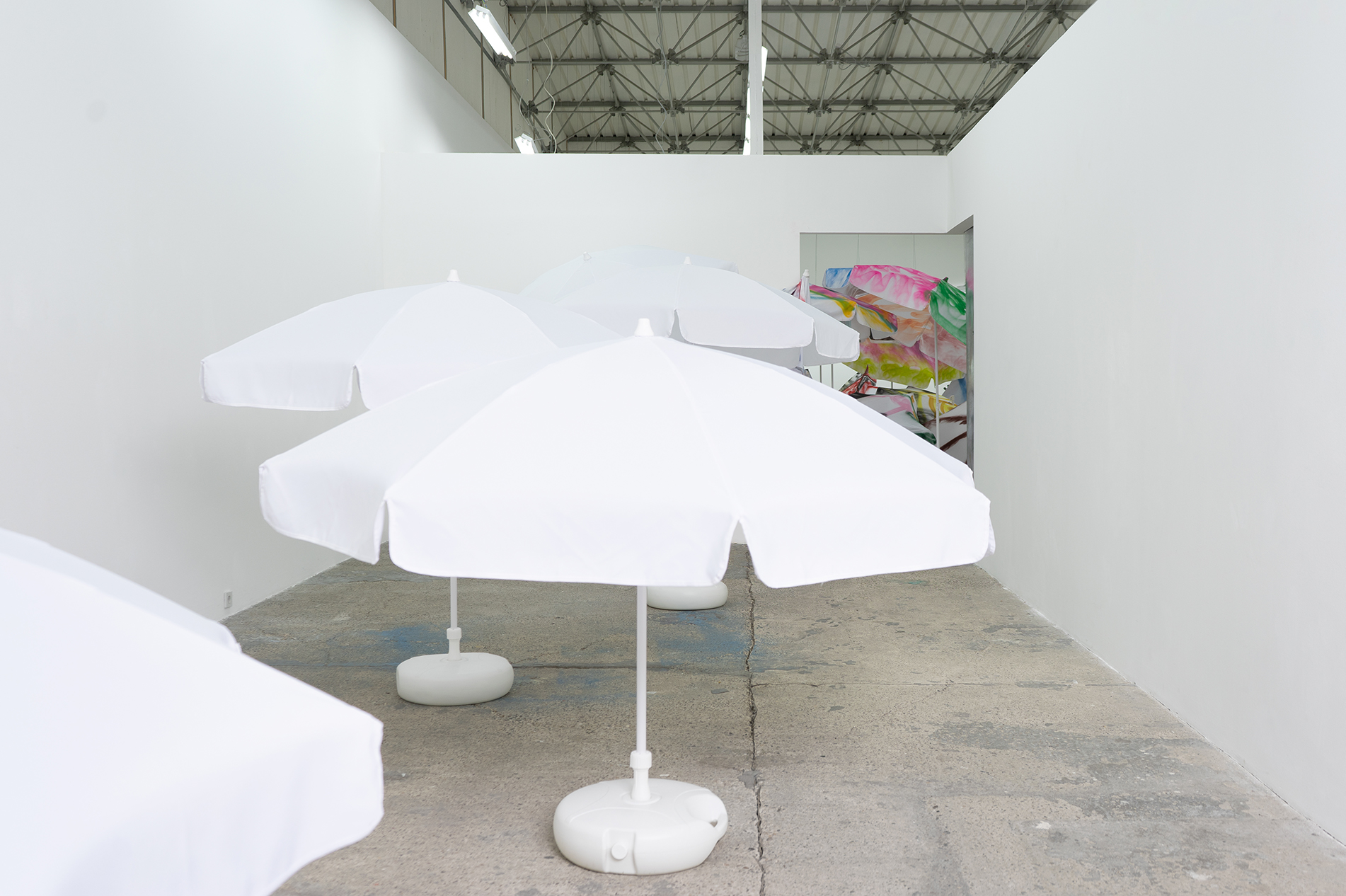
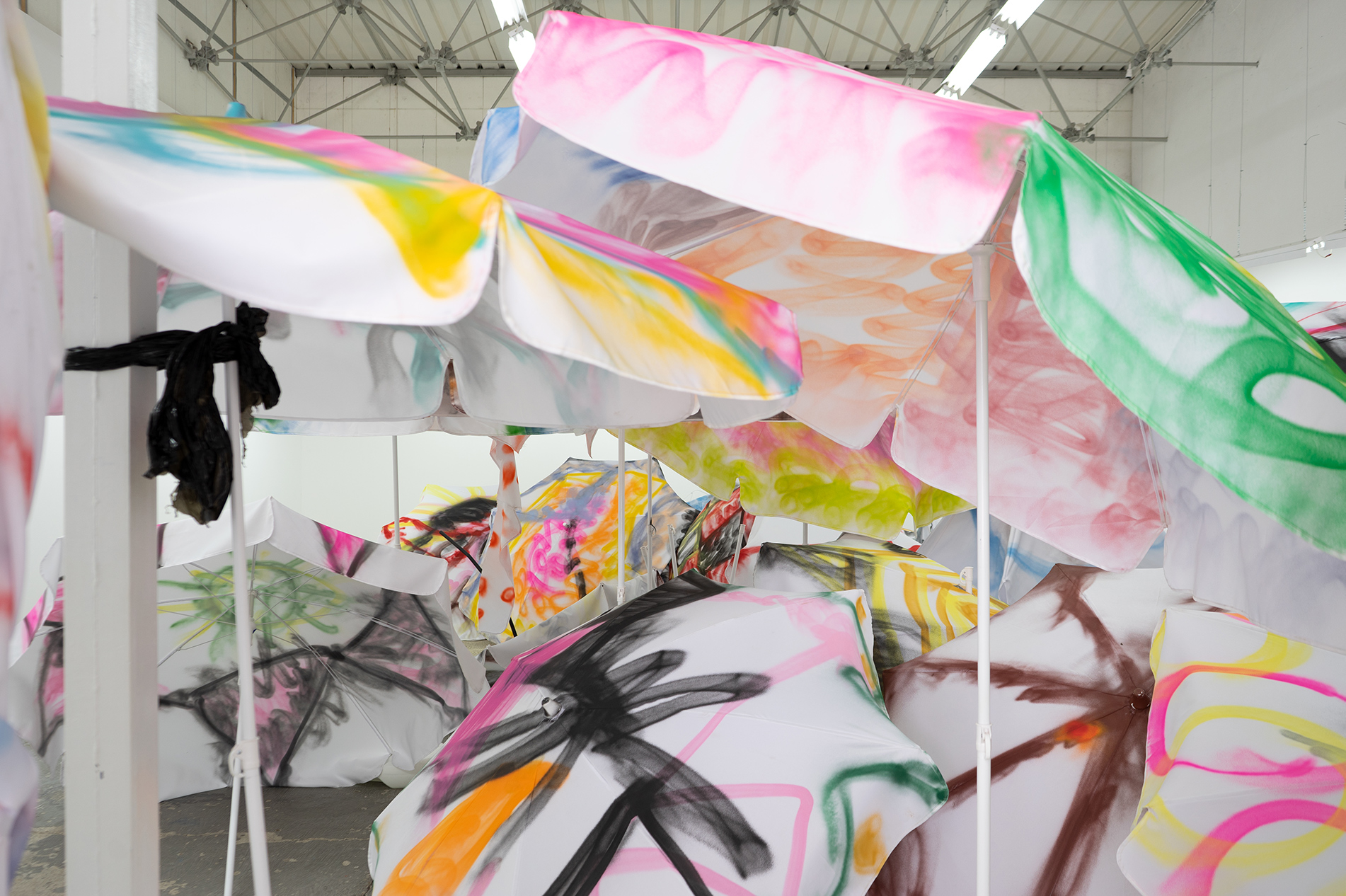
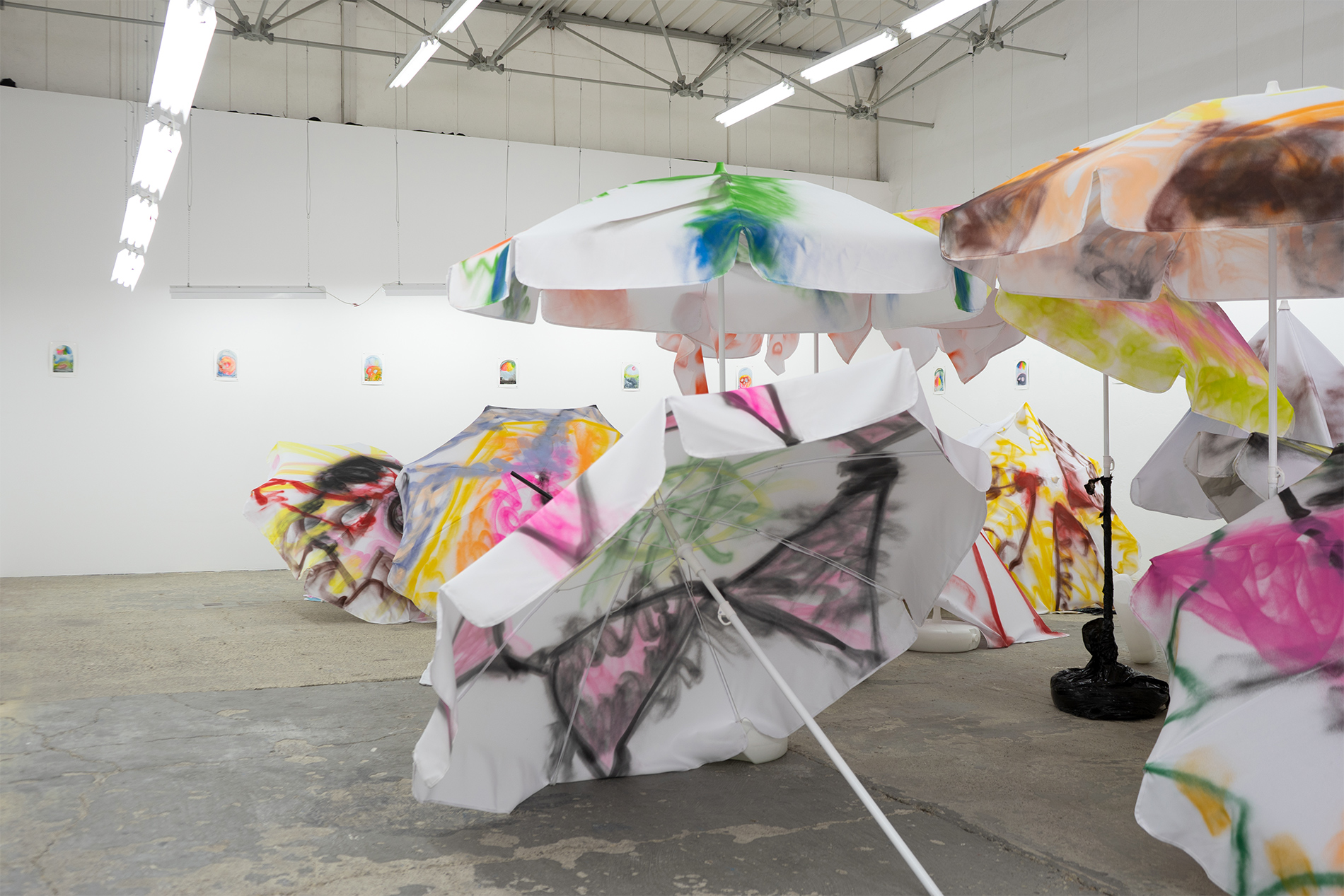
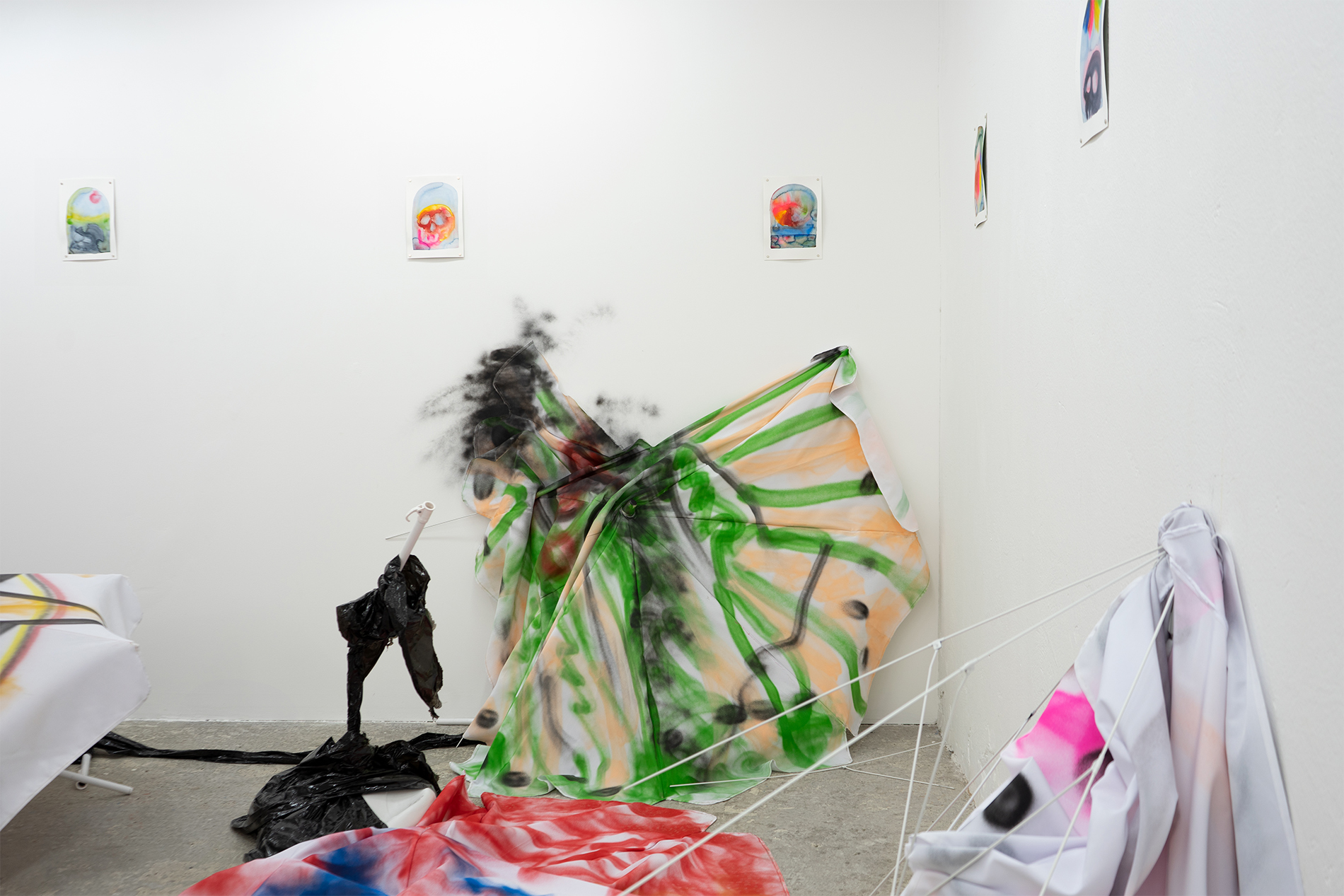
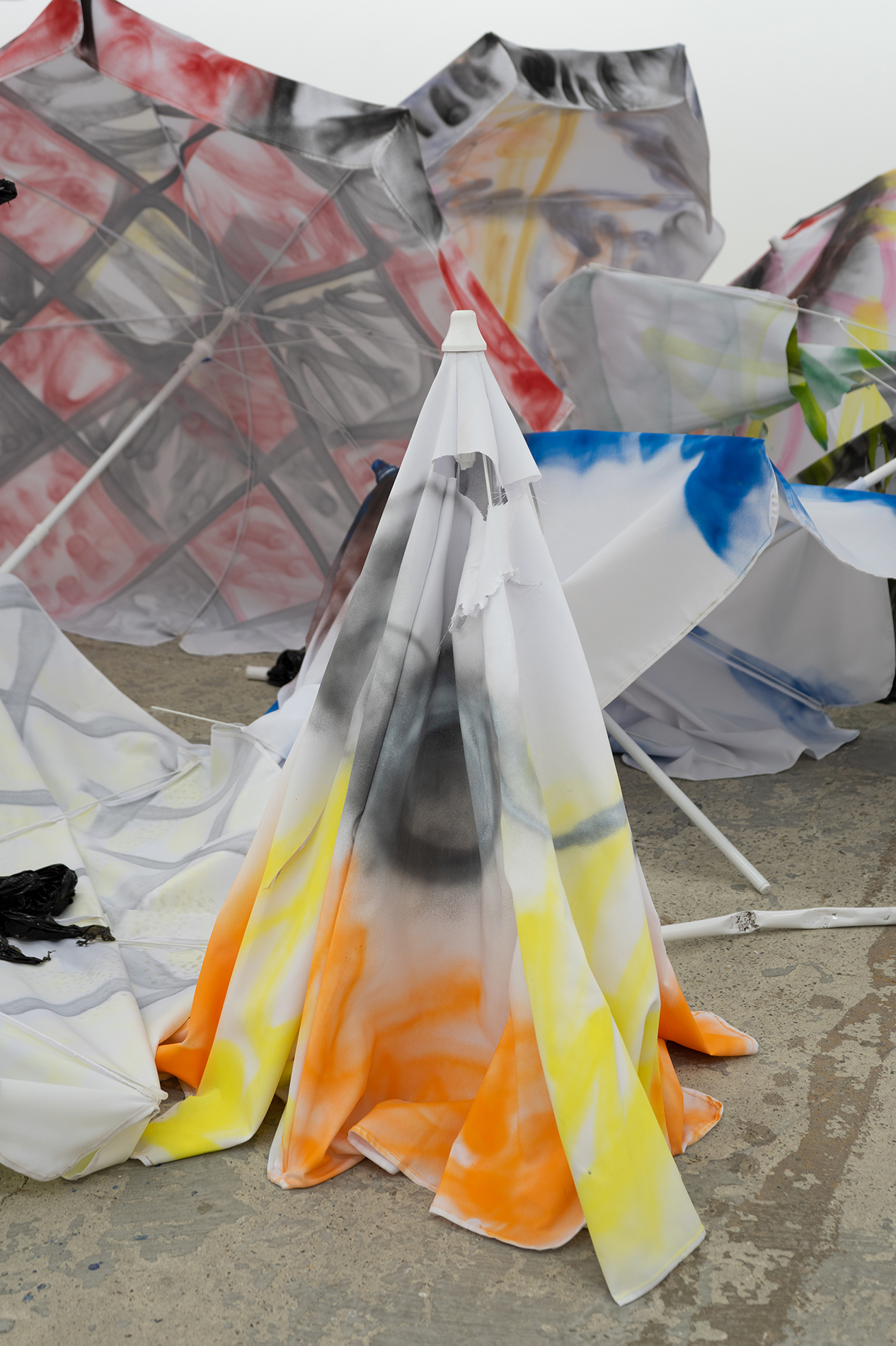
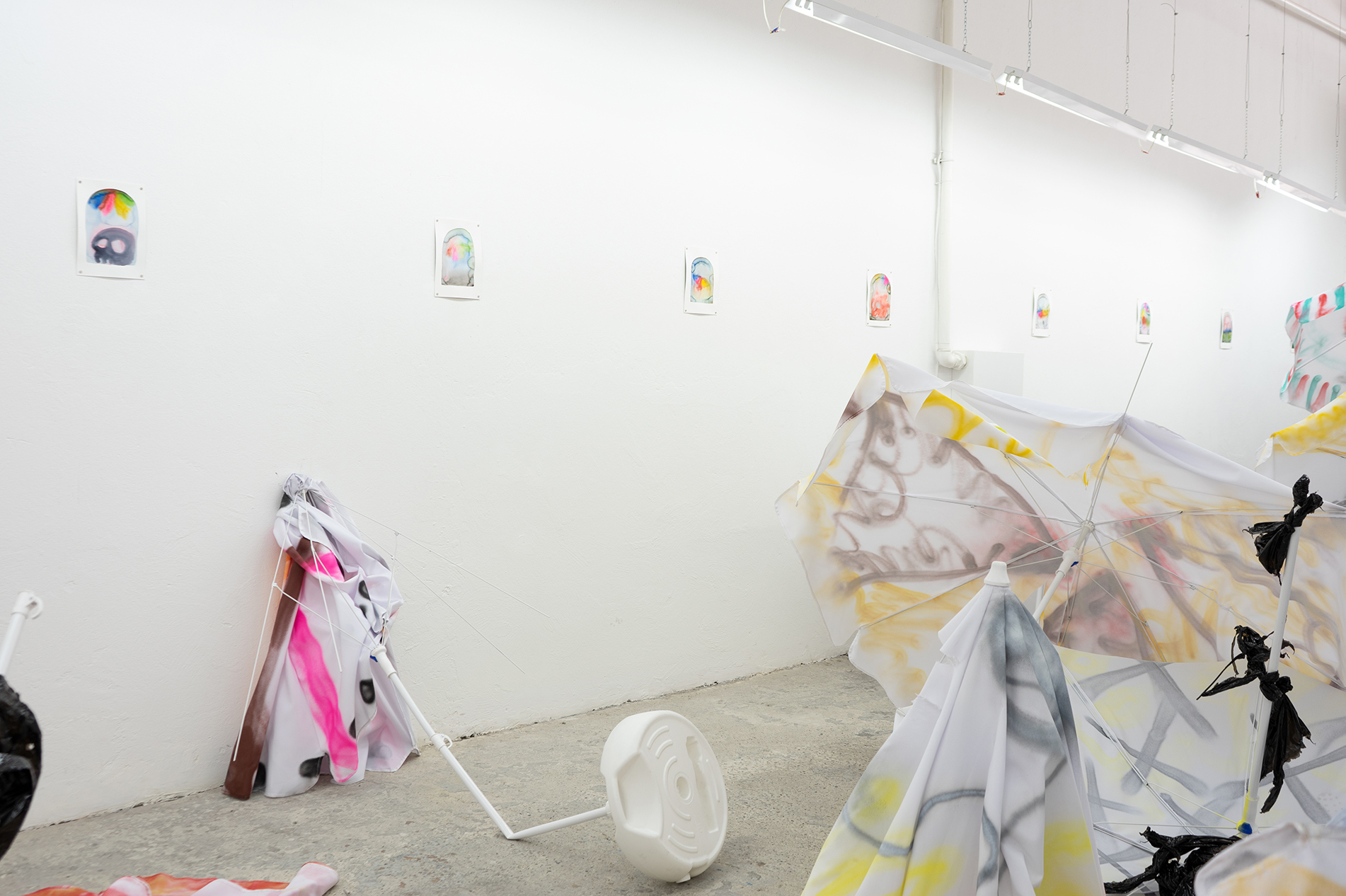
In 42 Square Meters of Shade, Stefan Inauen (b. 1976, Appenzell) approaches landscape as something to be abstracted, a place where perception is inscribed, where the world is seen, felt, and questioned. Situating forty parasols within the gallery space, the artist creates a destabilized visual hierarchy. Entering the gallery, the viewer is confronted with clean, white, stable forms that guide us toward the main room, the dominant space of encounter where painted, misaligned, bent, and inverted parasols face our direction. Some stand upright, others tilt or remain closed, leaning on one another in search of support. Almost every parasol reads as a body of its own; metal ribs like arms and legs. Some stand alert, while others slump, exhausted and worn out. Paint behaves more like an atmosphere than an image. It slips across fabrics forming saturated color fields, leaving behind bursts, stains, and symbols, almost like thoughts that didn’t fully land. The parasols have long lost their function. No longer a collection of objects, they form a spatial condition the visitor inhabits rather than observes. Despite its scale, the installation maintains a close bodily presence, reflecting the tactile and process-driven approach central to Inauen’s practice.
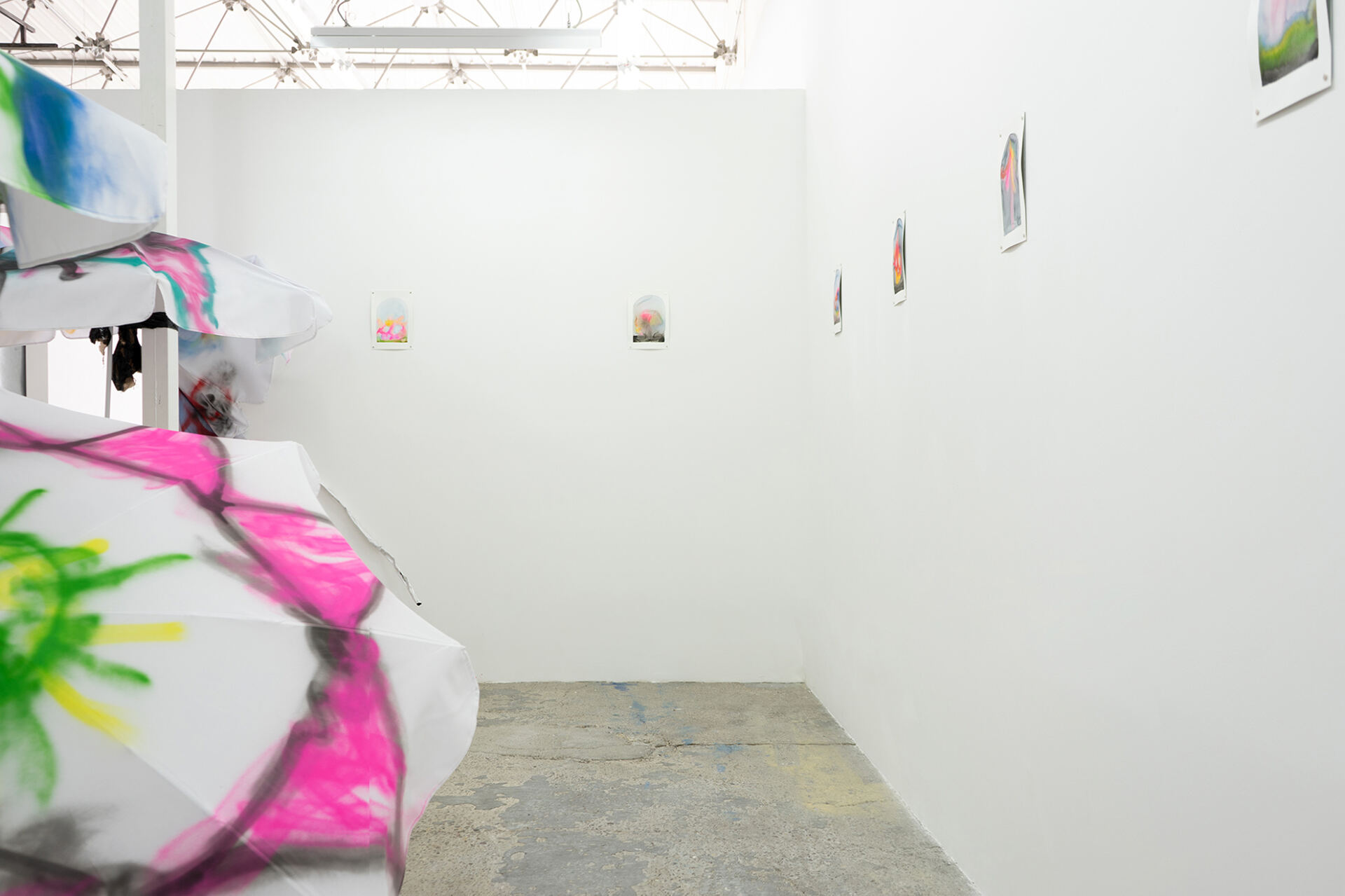
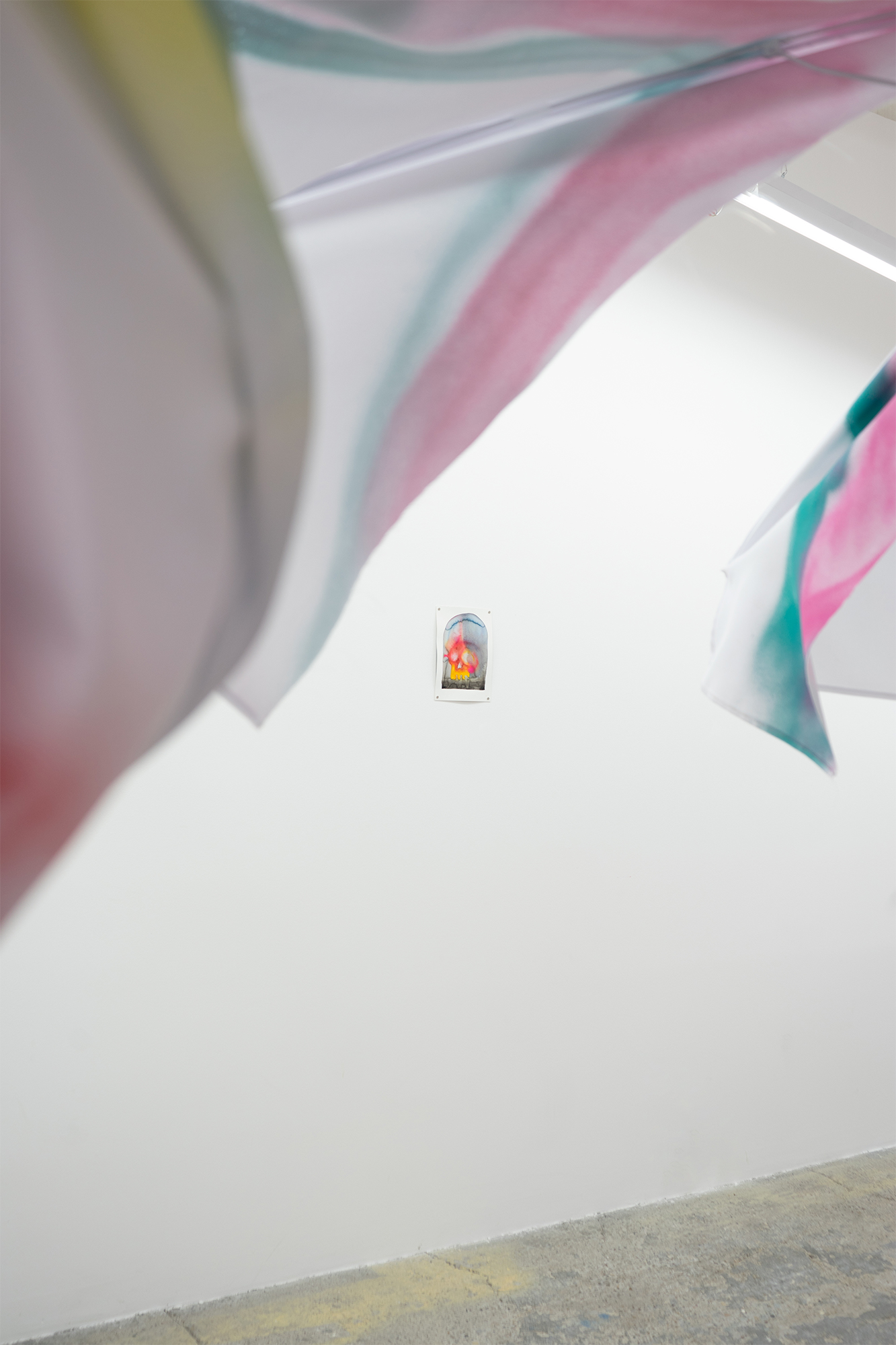
Around the room, thirty watercolors on paper, titled Soft Collapse (2026), form a continuous frieze. Like an arcade, each work contains dispersing symbols, predominantly skulls, set within painted architectural niches. Installed above eye level, they conjure a sacred realm: a measured, dignified passage whose importance is felt as much through its rhythmic order as through its silences. In ancient Roman temples, the niche was reserved for the divine, a stone void that made a god present in the physical world. In Inauen’s niches, dissolved pigments and symbols take that place, hovering between graven image and vanitas, an offering insistent on the certainty of passing time.
What the exhibition ultimately proposes is not a scene to be admired but a condition to be felt. The parasols do not shelter as much as they bear witness – to exhaustion, to the weight of being present in a world that is difficult to look at directly. Disarmingly inviting, colorful and cramped, the work pulls the viewer through and into it. Inauen’s landscape is the one you can get lost in precisely because you are already inside it.
– Tamara Knežević
42 Square Meters of Shade
42 Square Meters of Shade
2026
Installation view 42 Square Meters of Shade at Eugster || Belgrade, Serbia
Photo: Tamara Knežević
2026
Installation view 42 Square Meters of Shade at Eugster || Belgrade, Serbia
Photo: Tamara Knežević
42 Square Meters of Shade
42 Square Meters of Shade
2026
Installation view 42 Square Meters of Shade at Eugster || Belgrade, Serbia
Photo: Tamara Knežević
2026
Installation view 42 Square Meters of Shade at Eugster || Belgrade, Serbia
Photo: Tamara Knežević
42 Square Meters of Shade
42 Square Meters of Shade
2026
Installation view 42 Square Meters of Shade at Eugster || Belgrade, Serbia
Photo: Tamara Knežević
2026
Installation view 42 Square Meters of Shade at Eugster || Belgrade, Serbia
Photo: Tamara Knežević
42 Square Meters of Shade
42 Square Meters of Shade
2026
Installation view 42 Square Meters of Shade at Eugster || Belgrade, Serbia
Photo: Tamara Knežević
2026
Installation view 42 Square Meters of Shade at Eugster || Belgrade, Serbia
Photo: Tamara Knežević
42 Square Meters of Shade
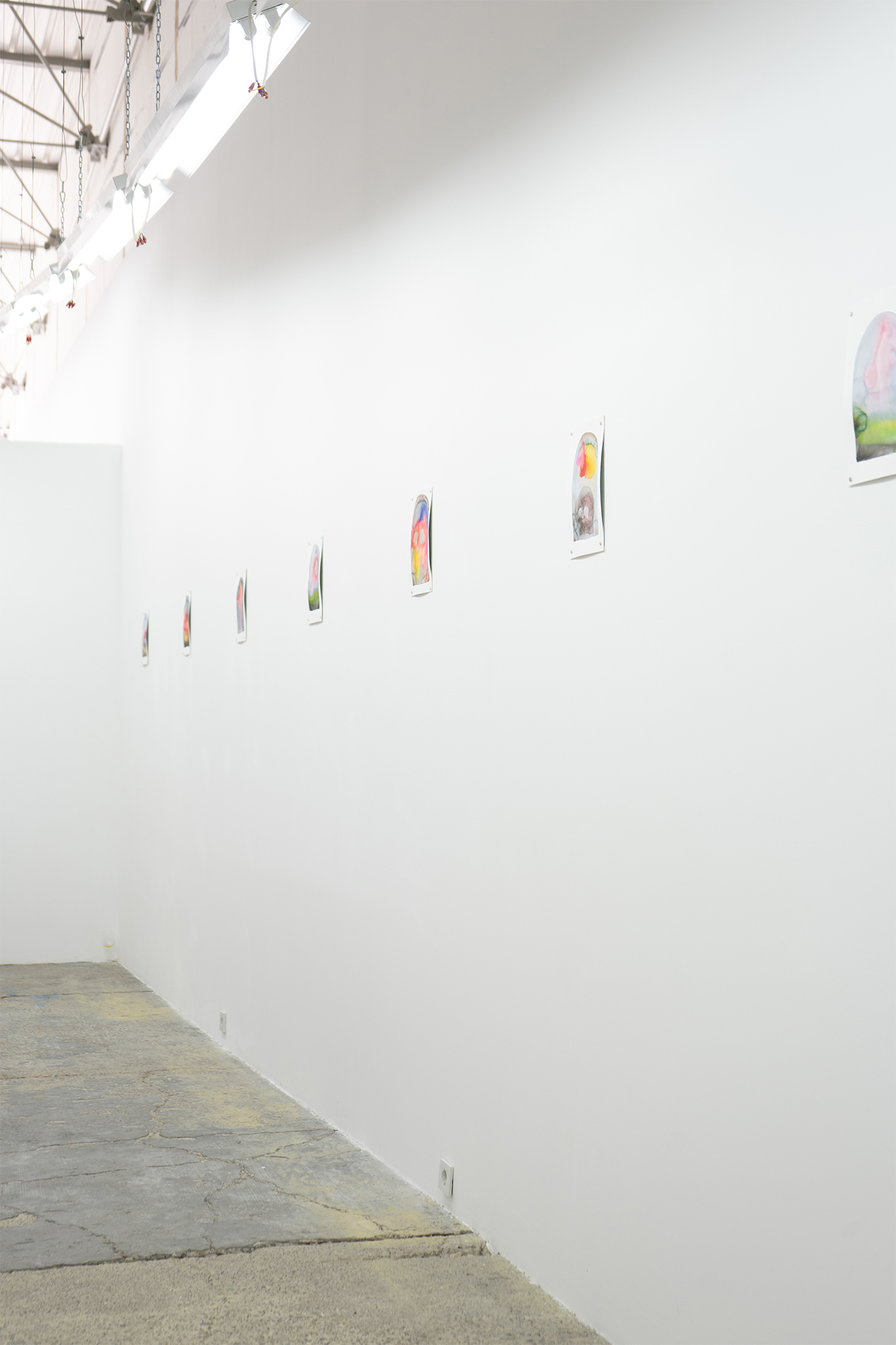
42 Square Meters of Shade
2026
Installation view 42 Square Meters of Shade at Eugster || Belgrade, Serbia
Photo: Tamara Knežević
2026
Installation view 42 Square Meters of Shade at Eugster || Belgrade, Serbia
Photo: Tamara Knežević
42 Square Meters of Shade
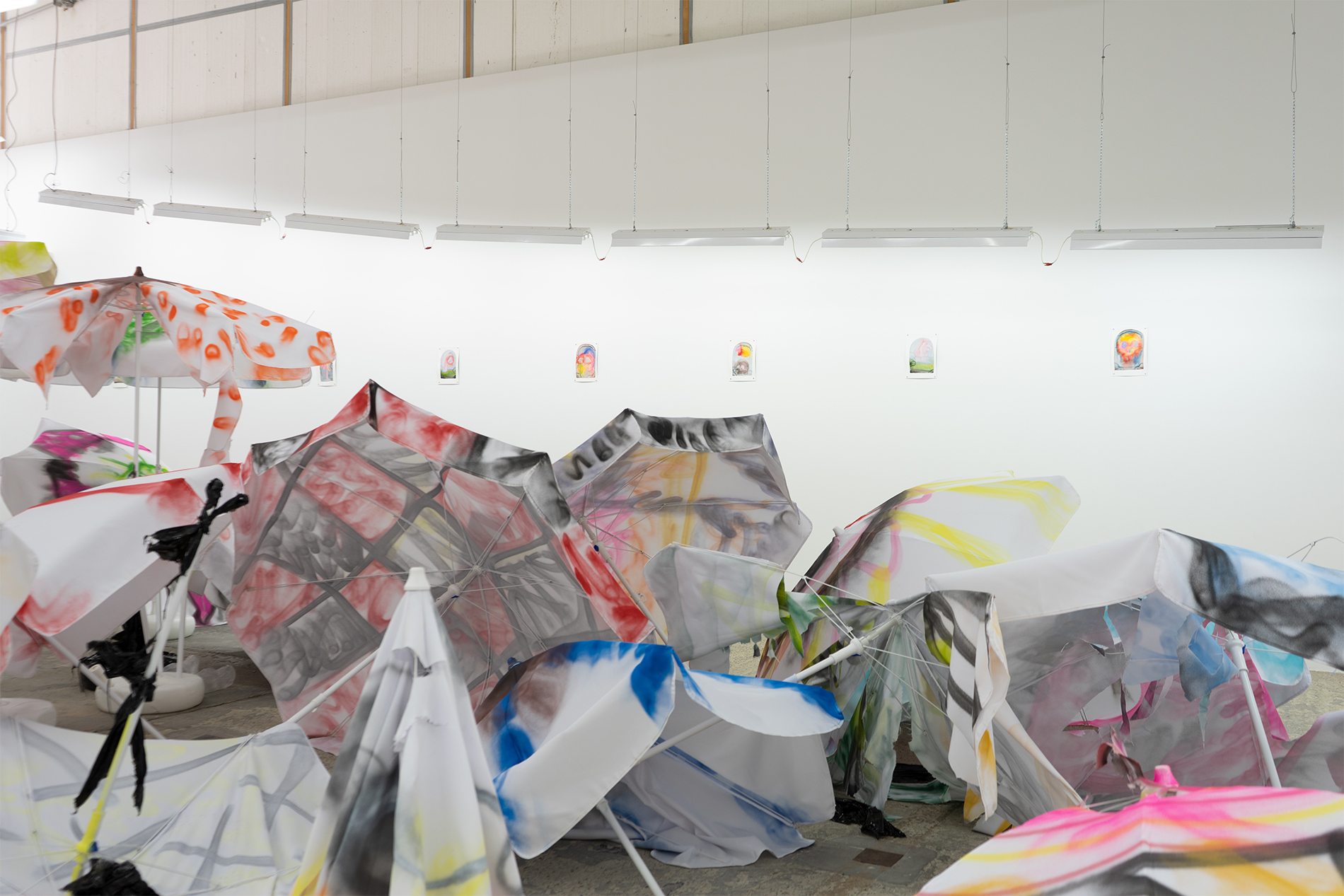
42 Square Meters of Shade
2026
Installation view 42 Square Meters of Shade at Eugster || Belgrade, Serbia
Photo: Tamara Knežević
2026
Installation view 42 Square Meters of Shade at Eugster || Belgrade, Serbia
Photo: Tamara Knežević
42 Square Meters of Shade
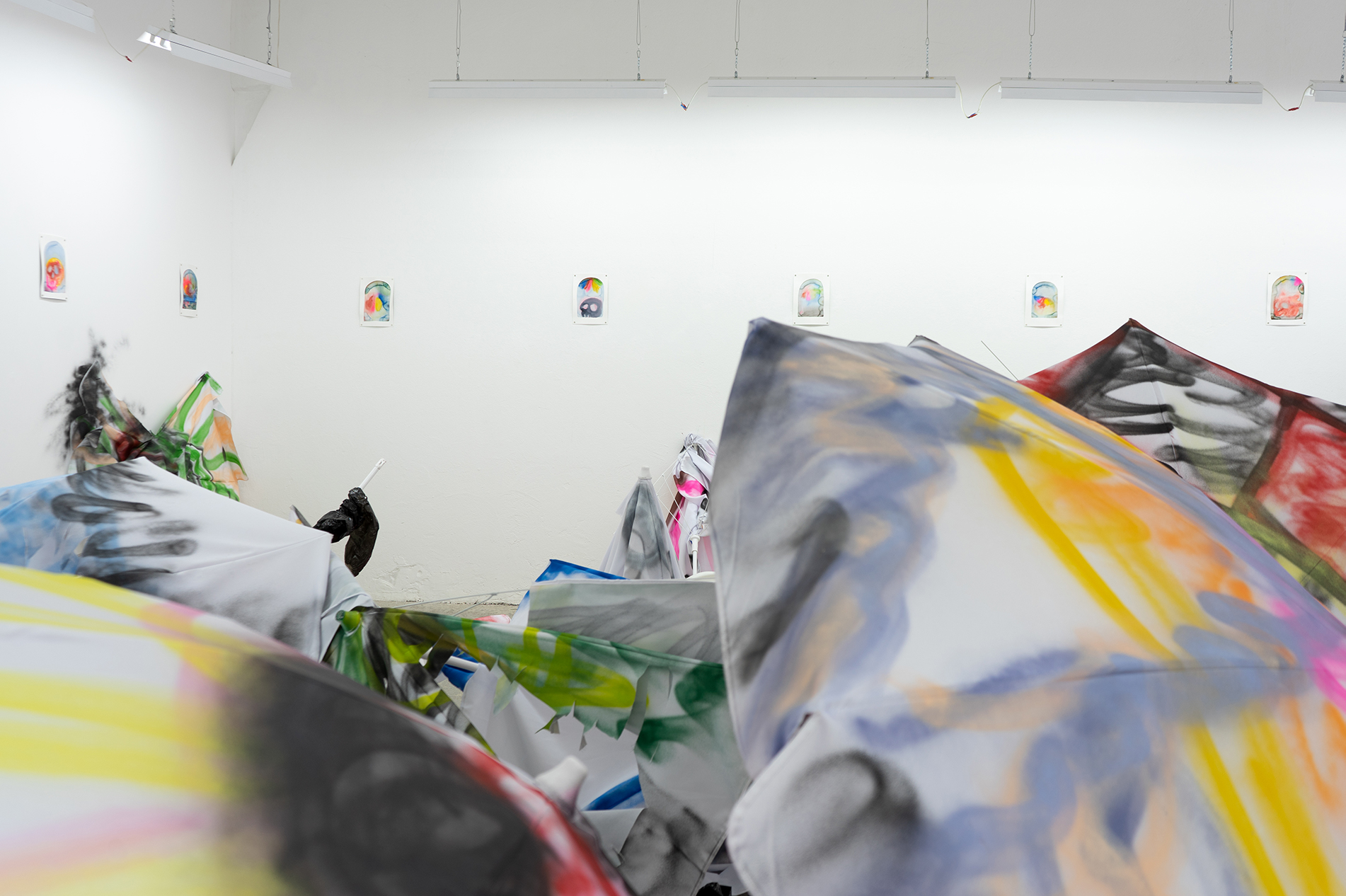
42 Square Meters of Shade
2026
Installation view 42 Square Meters of Shade at Eugster || Belgrade, Serbia
Photo: Tamara Knežević
2026
Installation view 42 Square Meters of Shade at Eugster || Belgrade, Serbia
Photo: Tamara Knežević
42 Square Meters of Shade
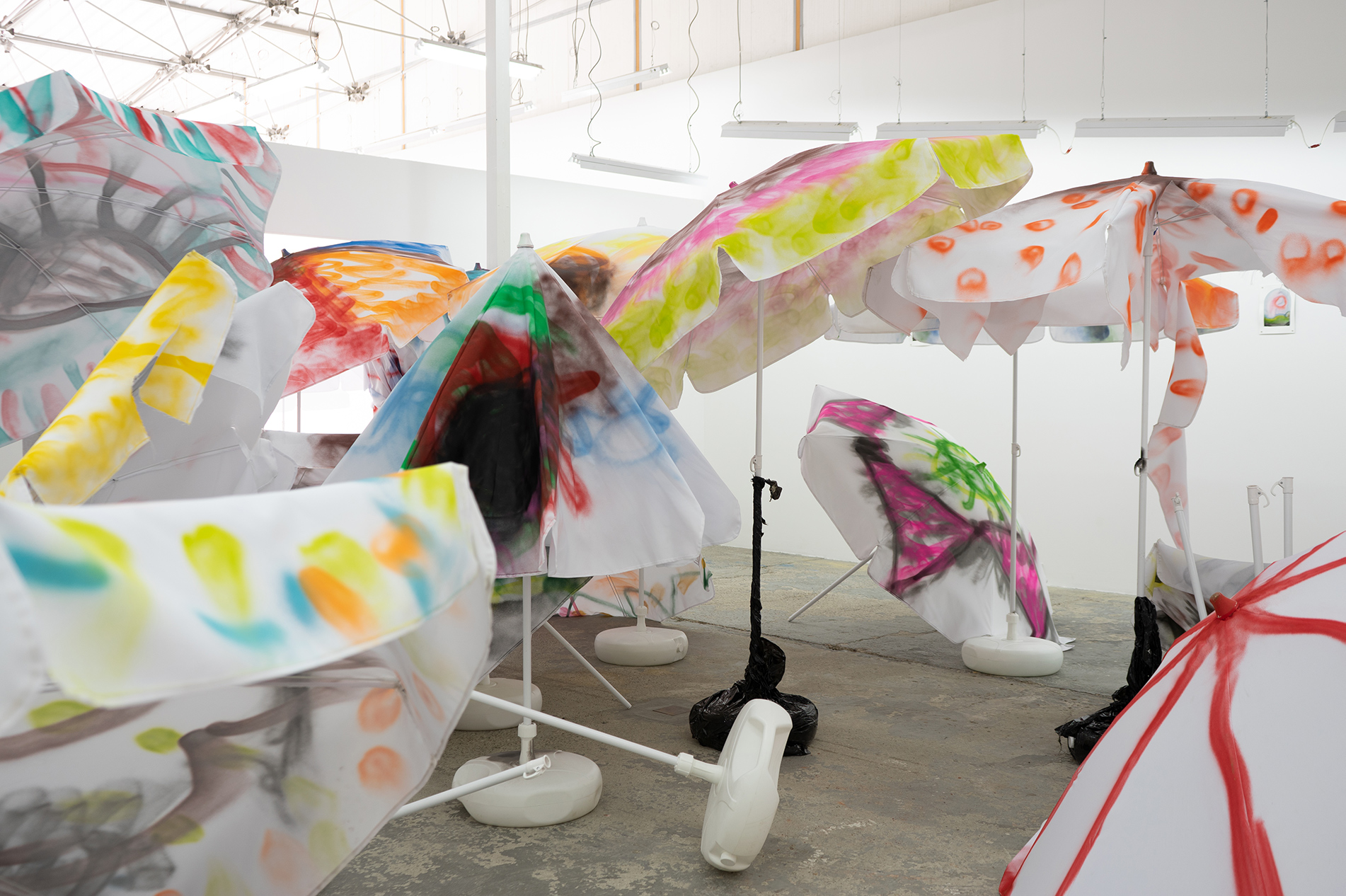
42 Square Meters of Shade
2026
Installation view 42 Square Meters of Shade at Eugster || Belgrade, Serbia
Photo: Tamara Knežević
2026
Installation view 42 Square Meters of Shade at Eugster || Belgrade, Serbia
Photo: Tamara Knežević
42 Square Meters of Shade
42 Square Meters of Shade
2026
Installation view 42 Square Meters of Shade at Eugster || Belgrade, Serbia
Photo: Tamara Knežević
2026
Installation view 42 Square Meters of Shade at Eugster || Belgrade, Serbia
Photo: Tamara Knežević
42 Square Meters of Shade
42 Square Meters of Shade
2026
Installation view 42 Square Meters of Shade at Eugster || Belgrade, Serbia
Photo: Tamara Knežević
2026
Installation view 42 Square Meters of Shade at Eugster || Belgrade, Serbia
Photo: Tamara Knežević
42 Square Meters of Shade
42 Square Meters of Shade
2026
Installation view 42 Square Meters of Shade at Eugster || Belgrade, Serbia
Photo: Tamara Knežević
2026
Installation view 42 Square Meters of Shade at Eugster || Belgrade, Serbia
Photo: Tamara Knežević
42 Square Meters of Shade
42 Square Meters of Shade
2026
Installation view 42 Square Meters of Shade at Eugster || Belgrade, Serbia
Photo: Tamara Knežević
2026
Installation view 42 Square Meters of Shade at Eugster || Belgrade, Serbia
Photo: Tamara Knežević
42 Square Meters of Shade

Soft Collapse II
2026
Watercolor on paper
21 x 29.7 cm
Unique
42 Square Meters of Shade

Soft Collapse III
2026
Watercolor on paper
21 x 29.7 cm
Unique
42 Square Meters of Shade

Soft Collapse IV
2026
Watercolor on paper
21 x 29.7 cm
Unique
42 Square Meters of Shade

Soft Collapse V
2026
Watercolor on paper
21 x 29.7 cm
Unique
42 Square Meters of Shade

Soft Collapse VI
2026
Watercolor on paper
21 x 29.7 cm
Unique